

Key Takeaways
- Match the role to the household: Estate managers, house managers, housekeepers, private chefs, personal assistants, chauffeurs, butlers, and property managers each solve a different operational problem.
- Write the job description before you search: Reporting lines, schedule, and the level of discretion required all shape who applies and who stays.
- Vetting takes more than a resume: A criminal record check, a credit bureau check, and a driver’s abstract, where the role calls for it, protect the household and the placement alike.
- Ontario law applies to household employees: The Employment Standards Act and, past a certain threshold, WSIB registration are not optional.
- A placement agency changes the search: A candidate database, structured vetting, and a working trial period cut down the odds of a mismatch.
- Retention starts at onboarding: Expectations set clearly in the first weeks tend to hold for years afterward.
Hiring household staff is a different exercise from hiring for a typical business role. The workplace is a family’s home, the reporting relationship is personal rather than corporate, and a poor fit affects daily life in ways an office hire never would. Private employers in Toronto searching for an estate manager, house manager, housekeeper, private chef, personal assistant, chauffeur, or butler need a process built for that reality: a clearly defined role, thorough vetting, an understanding of Ontario’s employment obligations, and a plan for onboarding that sets the placement up to last. This guide walks through each of those steps, along with where a specialist placement agency such as Charles MacPherson Associates fits into the process.
Why More Toronto Households Are Hiring Professional Staff
Running a large residence in Toronto now resembles running a small operation more than keeping a tidy house. Several properties, frequent travel, and a steady stream of contractors and vendors pull in different directions at once, and no single family member can hold all of it together unassisted. That is why so many private employers bring on dedicated staff instead of patching gaps with occasional help.
The Shift Toward Structured Household Support
A generation ago, hiring household staff usually meant a single housekeeper, or perhaps a part-time driver. Private households today are more likely to build a small team: a house manager or estate manager overseeing housekeepers, a chauffeur, and in some cases a private chef. Behind that shift sits a simple fact: Modern private life has grown genuinely complex, and someone has to own the coordination between the household’s calendar, the family’s schedule, and the staff’s own hours.
Employers who wait until a crisis forces the issue tend to hire under pressure. A caregiver leaves without notice, or a property sits unmanaged during a long trip abroad, and suddenly the household is settling for whoever happens to be available that week. Planning the role well before the need turns urgent produces a far better result, and it gives you room to be selective.
What Makes Toronto’s Private Service Market Different
Toronto is one of a small number of Canadian cities where genuinely experienced private service candidates exist in meaningful numbers. Many have trained or worked abroad, in London, New York, or the Gulf, before settling here, and they arrive with expectations around discretion and professional standards that a first-time household employer rarely anticipates. Reaching those candidates is the harder part of the equation. Experienced estate managers and house managers in this city rarely advertise themselves; they move between placements through referrals and agencies that are already familiar with their work and references.
Defining the Role Before You Start Searching
The single most common mistake in private hiring is starting the search before the role has been defined. A vague sense that “we need help” results in a flood of unsuitable applicants and a hire that unravels within months. Before contacting anyone, decide precisely which role the household needs.
Estate Managers and House Managers
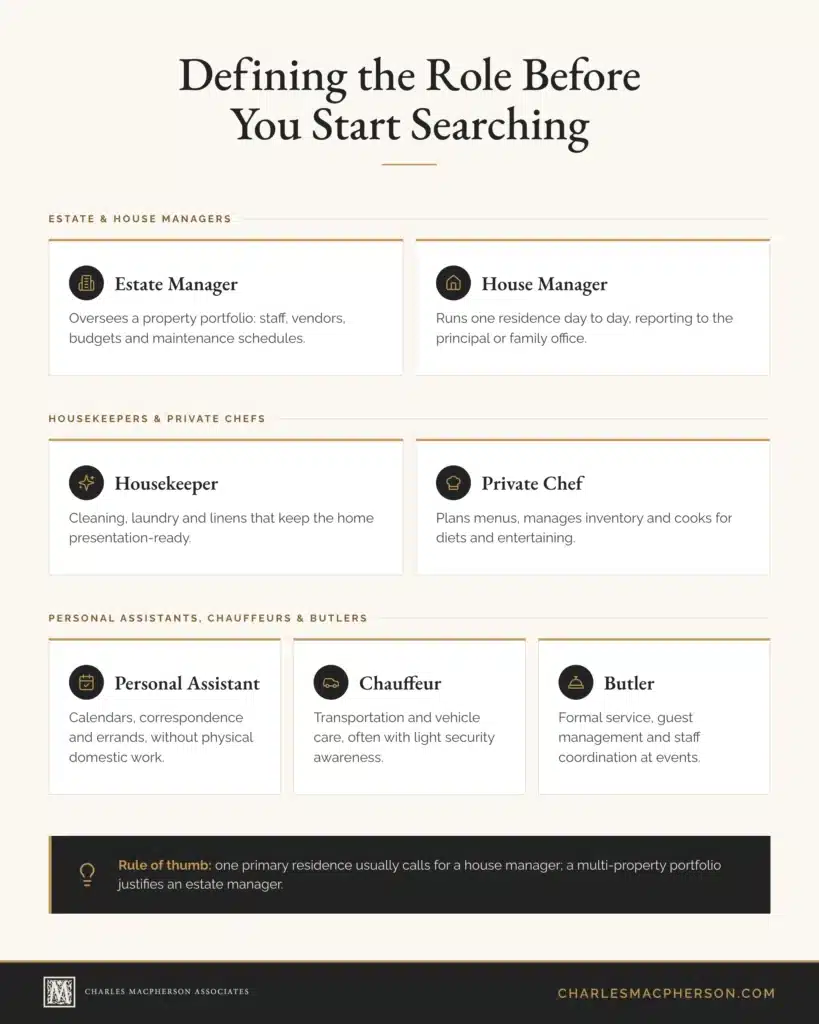
An estate manager oversees an entire property or a portfolio of properties, taking responsibility for staff supervision, vendor relationships, budgets, and maintenance schedules. A house manager operates at a similar level but is generally tied to a single residence, running the day-to-day operation and reporting directly to the principal or to the family office. Households with one primary residence, a full staff roster, and the need for a single point of accountability usually look toward a house manager first, while multi-property portfolios tend to justify an estate manager.
Housekeepers and Private Chefs
Housekeepers handle the physical upkeep of the home: cleaning, laundry, linens, and the daily maintenance that keeps a residence presentation-ready. Private chefs and personal chefs plan menus, manage kitchen inventory, and prepare meals to the household’s dietary requirements and entertaining schedule. Both roles reward specificity in the job description. A housekeeper hired for general cleaning will not necessarily have the training for fine textiles or antiques, and a chef hired for family meals may need very different skills from one hired primarily for large-scale entertaining.
Personal Assistants, Chauffeurs and Butlers
A personal assistant manages calendars, correspondence and personal errands for the principal, working closely alongside household staff without taking on physical domestic work. Chauffeurs, sometimes called private drivers, handle transportation and vehicle maintenance, and many households value a chauffeur who can also assist with light security awareness during transit. Butlers oversee formal service, particularly around entertaining and guest management, and in many households they take on a coordinating role among other staff during events.
Writing a Job Description That Attracts Qualified Candidates
Once the role is defined, put it in writing. A strong job description does more than list duties. It signals to serious candidates that the household knows what it needs, filtering out applicants who are not a genuine fit before the interview stage even begins.
Responsibilities and Reporting Lines
List the core responsibilities in order of priority rather than as an undifferentiated block, and state clearly who the role reports to. Candidates for senior positions, an estate manager or house manager especially, will ask about this early, because reporting lines determine how much authority they will actually have day to day.
Schedule, Discretion and Household Culture
Be specific about hours, live-in or live-out arrangements and travel expectations, since ambiguity here is one of the leading causes of early departures. Discretion also deserves direct treatment in the description rather than an assumption that it goes without saying. Households that entertain frequently, or that value strict confidentiality around family matters, should state that plainly, because the candidates suited to that environment will recognise the signal and the ones who are not will self-select out.
Where to Find Household Staff in Toronto
Once the role and the job description are settled, the question becomes where to actually find candidates. Toronto’s private employers generally choose between two paths: working with a specialist placement agency, or running the search independently through job boards and word of mouth. The two approaches differ sharply in the calibre of candidate they reach and in who carries the burden of vetting.
Working With a Private Staffing Agency
Charles MacPherson Associates has placed household staff for high-net-worth and ultra-high-net-worth families since 1996, and the value of working with a placement team of this kind comes down to access and process. Rather than posting a role publicly and sorting through an unfiltered pile of applications, you work with a placement team that already maintains a database of vetted, experienced candidates, along with a network built through years of headhunting within the private service field. CMA’s placement team also brings a consultative approach to the search itself: a thorough consultation to understand the specific needs of your residence, a custom job description built around that conversation, and guidance on how to structure the hiring, onboarding, and management of the role that follows. Placements are full-time and permanent, backed by comprehensive background checks, which include criminal record, credit bureau, and driver’s abstract screening, and by a 60-day placement guarantee.
Where Independent Searches Fall Short
Advertising a household role directly, whether through a general job board or word of mouth, still reaches candidates, but it rarely reaches the strongest ones. Experienced private service professionals are seldom searching public listings, because their next placement typically comes through a referral before the role is ever posted. An independent search also puts the full weight of vetting on the household: verifying references, running background checks, and confirming work history all fall to you, and without an established process, discrepancies are easy to miss.
Vetting and Interviewing Candidates
A strong candidate on paper and in an interview is not the same as a strong candidate in the household. Vetting closes that gap through background checks, reference calls, and an interview process structured to surface more than a polished first impression.
Background Checks and Reference Verification
A resume shows what a candidate wants you to see. A background check shows the rest. In Canada, employers can request a criminal record check through the RCMP or local police, confirmation of employment history, and, for roles involving driving, a driver’s abstract. Standard checks typically take five to ten business days, while criminal record checks or international verifications may need two to four weeks. Consent from the candidate is required before a criminal record check goes ahead, and the check itself should relate directly to the responsibilities of the role. Reference checks are just as important and are frequently rushed. A useful reference call goes beyond confirming dates of employment and asks about the working relationship itself: how the candidate handled a difficult week, how they responded to correction, and whether the previous employer would rehire them without hesitation.
Structuring a Useful Interview
Treat the first interview as a chance to confirm the basics: experience, availability, and whether the candidate’s expectations match the role as written. Save the deeper questions, judgment under pressure, discretion around sensitive situations, and how the candidate has handled competing priorities in a previous household, for a second conversation once both sides have decided the fit is worth pursuing further. A working trial, arranged after the interview stage, remains the most reliable way to confirm that a candidate performs as well in practice as they did across the table.
Understanding Your Legal Obligations as a Household Employer
Hiring someone to work in your home makes you an employer in the eyes of Ontario law, with the same core obligations that apply to any other workplace. Private employers who overlook this, assuming that a household arrangement is somehow informal by default, tend to discover inconsistencies in perception only after a dispute or an injury has already happened.
Employment Standards Act Rules for Domestic Workers
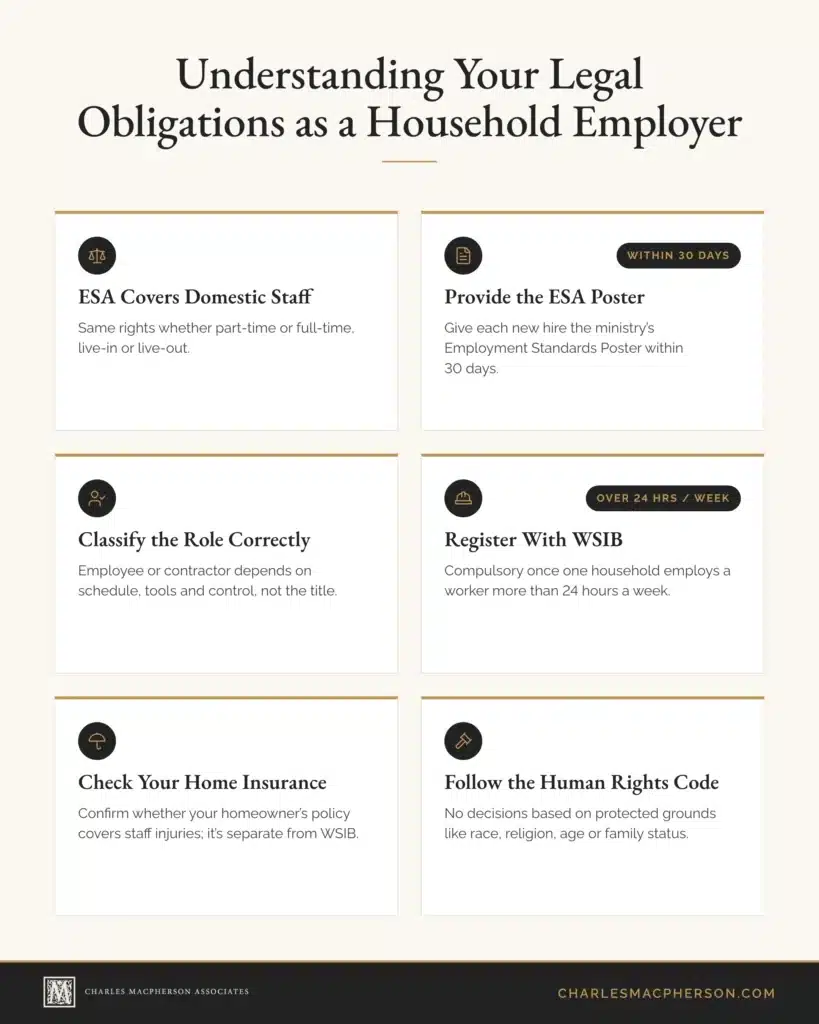
Domestic workers have the same rights under Ontario’s Employment Standards Act whether they work part-time or full-time, and whether they live in or out of their employer’s home. That coverage extends to hours of work protections and rest periods, and employers must provide staff with a copy of the ministry’s Employment Standards Poster within 30 days of the hire date. Whether a worker counts as an employee or an independent contractor depends on the nature of the relationship rather than on the title used in a contract, and factors such as who sets the schedule, who provides the tools, and how much control the household exercises over the work all weigh into that determination.
Getting the classification wrong carries real cost. A worker treated as a contractor who actually meets the legal test for an employee can leave a household exposed to back pay, penalties and disputes long after the placement has ended. CMA does not provide legal or payroll advice directly, and recommends that private employers consult an employment lawyer and a payroll provider experienced in domestic staffing before finalising a contract.
WSIB, Insurance and Human Rights Considerations
Workplace Safety and Insurance Board coverage becomes compulsory once a domestic worker is employed for more than 24 hours a week by a single household, with registration below that threshold remaining optional. Households should also confirm with their insurer whether a homeowner’s policy extends to injuries involving staff, since this protection is often separate from WSIB and easy to overlook until a claim arises. Ontario’s Human Rights Code applies throughout the hiring and employment relationship, meaning decisions cannot be based on protected grounds such as race, religion, sex, disability, age, or family status. A signed confidentiality agreement is worth building into any senior placement from the outset, given how much of a family’s private life a house manager, estate manager or personal assistant will inevitably see.
Onboarding and Keeping Great Staff Long Term
A successful hire does not end at the offer letter. How a household sets up the first weeks and months on the job has as much bearing on whether a placement lasts as the search that led to it.
Setting Up a Working Trial
A working trial, typically a set number of paid days or weeks before a formal offer, gives both sides a real look at the fit before committing long term. Use the trial period to observe how the candidate handles the household’s actual routines rather than a simulated version of them, and provide feedback along the way instead of saving every concern for a final review at the end.
What Supports Retention After Placement
Staff who leave within the first year most often cite unclear expectations rather than the work itself as the reason. A short onboarding document covering household preferences, security protocols, and points of contact prevents a great deal of early confusion, and a regular check-in, even a brief one, in the first three months catches small frictions before they become resignations. Long-term success also depends on treating the role as a genuine career rather than a temporary fix. CMA’s placements are exclusively full-time and permanent for this reason, since short-term arrangements rarely justify the investment either side puts into a strong working relationship.
How Charles MacPherson Associates Supports Private Employers
Charles MacPherson Associates works with private residences and estates across Toronto and internationally, placing estate managers, house managers, housekeepers, personal assistants, private chefs, chauffeurs, butlers, and property managers on a full-time, permanent basis. The process begins with a consultation to understand the household’s specific requirements, followed by a custom job description and access to a candidate database built over nearly three decades. Every candidate is screened through comprehensive background checks, and every placement carries a 60-day guarantee. Founder Charles MacPherson also established The Charles MacPherson Academy, which sets training standards for private service professionals already working in the field and gives CMA’s placement team insight into what genuinely strong service looks like in a private household. Families considering a new hire, or looking to formalise a household team that has grown informally over time, can schedule a consultation to discuss the specific needs of their residence.
