

Key Takeaways
- CMA begins every engagement with a detailed consultation about your household before sourcing any candidates
- Every candidate is screened with a criminal record check, a credit bureau check, and a driver’s abstract before you see their profile.
- CMA places only full-time, permanent household staff, each backed by a 60-day placement guarantee
- Your recruiting account manager stays involved well after your new staff member starts, beyond the hiring stage itself.
- The process moves through five stages: consultation, sourcing, interviews, offer and onboarding, and ongoing support.
Charles MacPherson Associates opens every household staffing engagement with a conversation about your household, well before any candidate list gets built. If you have never hired through a private staffing agency before, that first exchange says a good deal about how the rest of the process will run: methodical and consultative, shaped around your household rather than a generic search. This guide walks through what a first-time employer can expect at each stage, starting with the initial consultation and carrying through to the support that continues once your new staff member has started.
Why First-Time Employers Turn to a Private Staffing Agency
Hiring someone to work inside your home differs from hiring for an office role in ways that only become obvious once the search is underway. The person you choose will see your household at its most unguarded moments and manage a schedule that shifts by the day. They will also represent your family to guests and to the wider circle of contractors, drivers and other staff who pass through the property. Many first-time employers only recognise how much judgement and discretion the role demands after a handful of interviews that go nowhere.
That is usually the point where a private staffing agency enters the picture. Founded in 1996, Charles MacPherson Associates has spent decades refining a process built around a single principle: the person has to suit the household. The job description alone cannot prove that.
The Difference Between Household Staffing and General Recruitment
General recruiters screen candidates for qualifications and availability. A household staffing agency screens for the same things, though the real work happens around them. Household roles ask candidates to read a family’s routines without being told, hold confidential information without slipping, and adjust their pace to whatever the day requires. None of that appears on a resume, so evaluating for it requires a different kind of interview.
CMA’s recruiting account managers develop that judgement over years of placements, learning what separates a candidate who interviews well from one who performs well once they are actually inside your home. The Charles MacPherson Academy, the only one of its kind attached to a private staffing agency, keeps that expertise current as service standards evolve.
What a Private Staffing Agency Actually Does for You
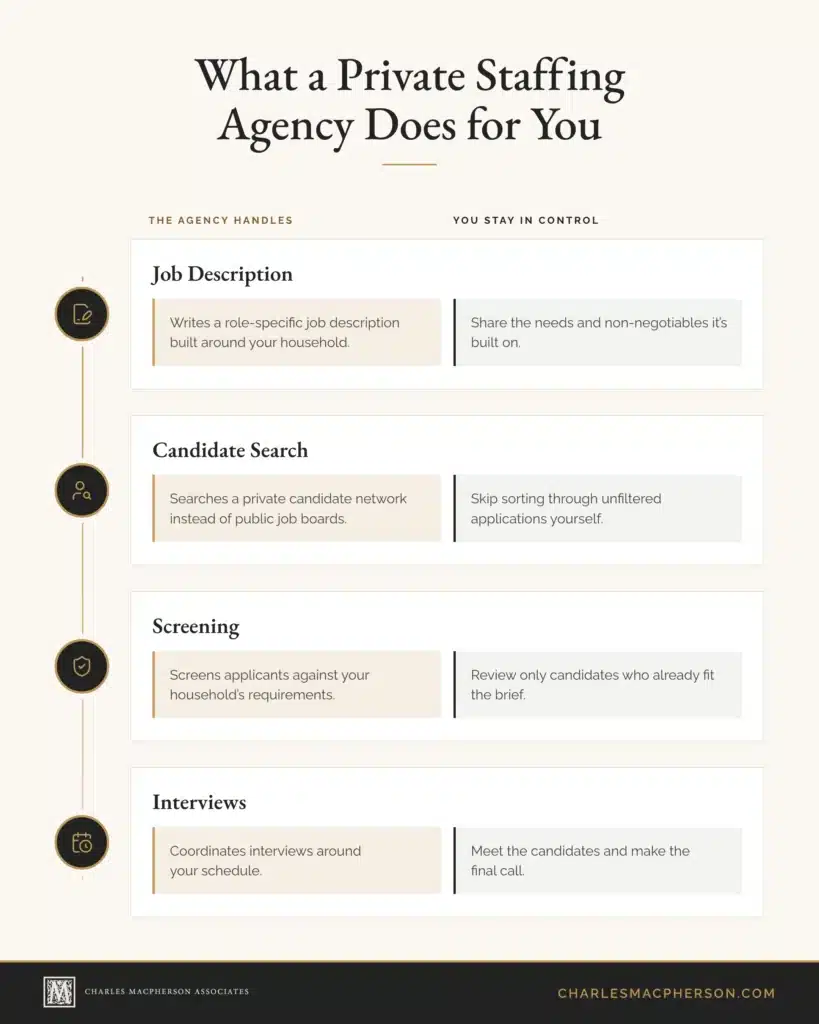
Once you engage CMA, a team manages the hiring process on your behalf. Your placement team writes a role-specific job description, searches a private candidate network, screens applicants against your household’s requirements, and coordinates interviews around your schedule. You stay in control of every decision along the way; the agency simply removes the burden of finding and filtering candidates yourself, along with the vetting work that follows. For most first-time employers, this is where the process becomes overwhelming.
Preparing for Your First Consultation
A little preparation before your first call makes the consultation more useful for both sides. You do not need a finished job description; your placement team will help build that. What helps is a clear sense of what prompted the search in the first place.
Questions to Ask Yourself in Advance
- What’s driving the search: A growing family, a recent move, or a staff member moving on
- Which tasks feel unmanaged: The gaps in your week that a new hire needs to close
- How the role fits with existing staff: Whether this is a first hire or an addition to a household team
- Your timeline: Whether you need someone in place within weeks or have more flexibility
What Your Placement Team Will Ask About Your Household
Expect questions about the rhythm of your household, when it is busiest and when it is quiet, and about how staff schedules should flow around family life. Your placement team will ask about the property itself, too, whether the role covers a single residence or multiple properties, along with any non-negotiables around experience, certifications, or personal qualities. These conversations happen by phone, video call, or in person, whichever suits you, and confidentiality is treated with the same seriousness regardless of format.
Building Your Job Description
With those details gathered, your placement team drafts a job description specific to your household rather than adapting a generic template. A precise job description does more work than most first-time employers expect. It sets the standard candidates are measured against from day one, and it gives you a clear reference point once you are comparing candidates later in the process. Vague job descriptions tend to produce vague candidates, so this step is worth the time it takes to get right.
How Candidates Are Sourced and Vetted
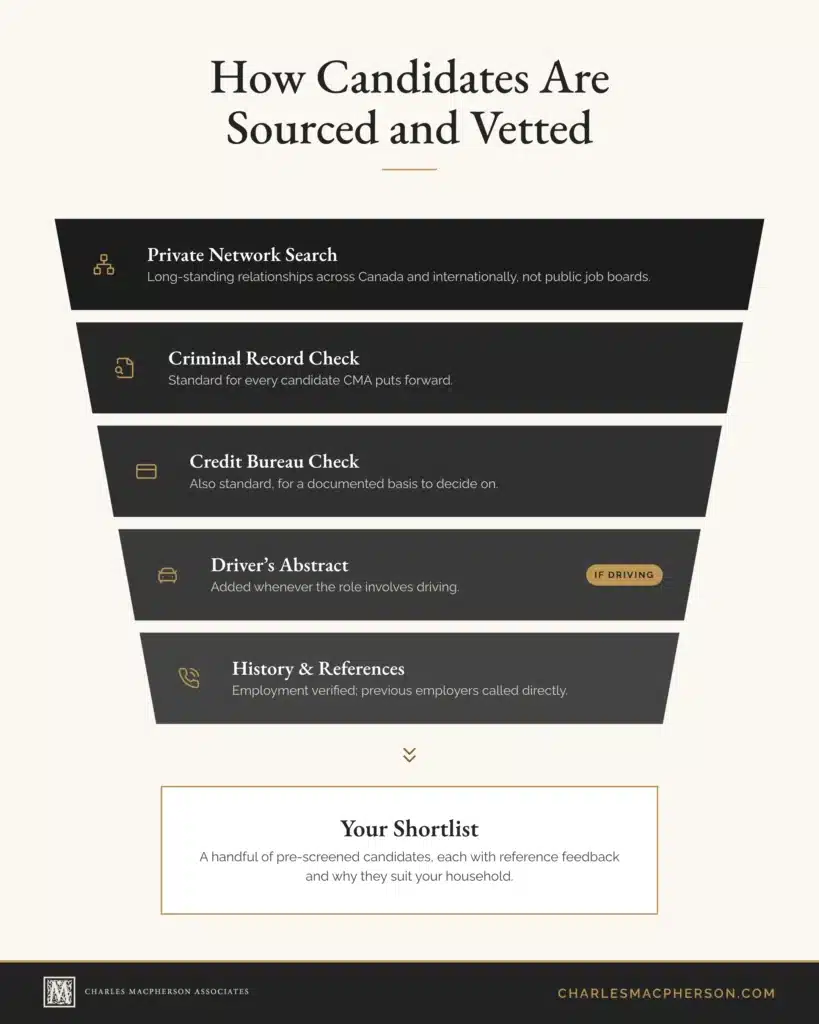
Once the job description is finalised, your recruiting account manager searches CMA’s private candidate network for people whose experience matches your household’s needs. This is not a public job board search. It draws on relationships built over years with private service professionals across Canada and internationally.
Background Checks and Verification
Every candidate CMA puts forward has already been through a background check before their profile reaches you. That includes a criminal record check and a credit bureau check as standard. Where the role involves driving, CMA also runs a driver’s abstract before the candidate is presented to you. These checks protect your household and give you a documented basis for the decision ahead of you, rather than relying on impressions alone.
Reference Checks and Working History
Alongside the background check, your placement team verifies employment history and speaks directly with previous employers. Reference conversations often say more about a candidate’s judgement and reliability than the interview does, particularly for roles like estate manager or house manager, where independent decision-making comes up daily rather than occasionally.
Reviewing Candidates and Conducting Interviews
Rather than a stack of resumes, you will receive a shortlist, usually a handful of candidates who have already cleared screening and background checks and whose experience lines up with your job description. Each profile includes a summary of their background, reference feedback, and the reasoning behind why your placement team believes they suit your household.
Structuring the Interview Process
You conduct the interviews. CMA supports the logistics: scheduling, format, and any follow-up questions you would like addressed before a second meeting. Some households prefer a single interview followed by a working trial; others want two or three rounds before deciding. Your recruiting account manager will advise on what has worked well for similar roles, though the pace of the process is set by you, not the agency.
Making an Offer and Onboarding Your New Staff Member
Deciding on a candidate is only the halfway point. How you extend the offer and how the first few weeks are structured often determine whether a placement lasts, so this stage deserves the same care as the search itself.
Working Trials and Setting Expectations
For many roles, it’s prudent to arrange a short working trial before you extend a formal offer. It gives the candidate a chance to work inside your household’s actual routine and gives you a chance to see how they handle it, something an interview alone cannot fully show. Setting clear expectations for the trial period, including what success looks like, helps both sides make a confident decision at the end of it.
What CMA Recommends for Contracts and Payroll
Once you have decided to move forward, CMA advises on best practice for structuring the role and setting expectations clearly from the outset. For the employment contract itself and for payroll administration, we recommend working with an employment lawyer and a payroll provider who specialise in household employment. Getting this right early avoids complications later, and it is worth treating seriously even when you are hiring a single member of staff.
The Placement Guarantee and Ongoing Support
Every full-time, permanent placement made through CMA carries a 60-day guarantee. If the placement does not work out within that window, your placement team restarts the search at no additional fee. That guarantee reflects how seriously CMA treats the vetting process, rather than acting as a safety net for a rushed match.
Support does not stop once your new staff member starts. Your recruiting account manager checks in periodically after the placement and remains available if questions come up about managing the role long term.
Roles You Can Hire Through Charles MacPherson Associates
CMA places full-time, permanent staff across a defined set of household roles. Every search is built around long-term success, so short-term or temporary arrangements sit outside what CMA offers.
- Estate managers
- House managers
- Property managers
- Housekeepers
- Personal assistants
- Private chefs and personal chefs
- Chauffeurs and private drivers
- Butlers
Setting Realistic Expectations on Timeline
Timelines vary by role and by how specific your requirements are. A house manager search in a major city typically moves faster than a search for an estate manager overseeing a rural property with a barn, guest cottages, and staff quarters, simply because the pool of qualified, available candidates differs by role and by location.
What stays constant is the sequence. Consultation comes first, then a defined search, then a shortlist you interview on your own schedule. Skipping any of those stages tends to produce worse outcomes, and a private staffing agency worth working with won’t cut corners just to close a placement quickly.
